
Earnings Estimates and Investment Decision Making
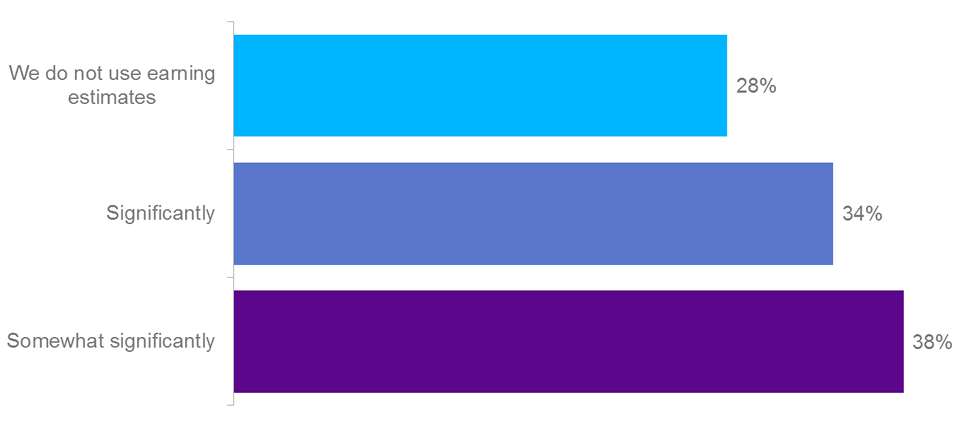
Earlier this week we polled CFA Institute Financial Newsbrief readers, asking, “To what degree do earnings estimates factor into your investment decision making?” Of 388 respondents, about 62% do, in fact, make use of earnings estimates in their work. Just under half of those who do use earnings estimates say they “significantly” factor into their process.
Passive investors have little reason to utilize earnings estimates, so presumably most of those responding to the poll are active investors. Currently active investors are enduring a high-pressure moment from clients, exchange-traded funds (ETFs), and the passive investment community. The perception, of course, is that there is little value-add brought to the client equation by active investing. Today, CFA Institute is hosting a Future of Finance online forum to discuss the future of active management.
Could it be that one source of alpha bleed is an overreliance on earnings estimates? After all, earnings have a poor history of predictive power for future equity returns as demonstrated by many studies. Also, earnings estimates may anchor active investors to some potential bad habits, such as:
- Short-termism
- Lack of independent judgment
- Higher turnover/higher trading costs
To what degree do earnings estimates factor into your investment decision making?
Short-Termism
Does using earnings estimates create a mindset among investors that what happens in the upcoming quarter or year earnings-wise is important? Does making or missing a quarterly number really matter to the health of a business over the long term?
For example, I remember Costco (COST) missing a quarterly earnings number in May 2000 by a negligible amount ($0.01–$0.02) due to its having completed construction of several stores ahead of schedule. In turn, that meant that its pre-opening costs for new facilities increased — hence the earnings miss. Yet, long term, this was a great development for the business. Shares fell over 20% in one day, and over the course of the next two days the firm for which I worked became Costco’s largest shareholder. As a long-term investor, the firm understood that the earnings miss was actually good news for the business, if not for the stock.
Lack of Independent Judgment
In my experience, most investors do not create their own earnings estimates. At best, they tweak the consensus earnings estimate to reflect their unique view of a company, or investors tweak their favorite sell-side analyst’s estimate for a business. But at worst they just plug the consensus into their decision-making process. All of this is fine if an investment company consistently generates returns exceeding its benchmark.
Could it be that there is too much groupthink in investment decision making, groupthink driven, in part, by orienting the research process toward a single number — the earnings estimate? Even those active investors who create their own valuation models frequently check the model’s quality by seeing if it can generate the quarterly earnings estimate number within the consensus range. Many also check their models with the management of the businesses they are evaluating to ensure it is “correct” relative to future earnings. Where is the independent judgment?
Higher Costs
Presumably people are using earnings estimates because they believe them to be critical to the investment process and hence contain actionable information. If so, then they are likely to trade on this information, too. Yet because of commissions, more trades equal more alpha drag. Also, some may trade more to pay back sell-side firms for their “research” and the earnings estimates that are central to that research. Again, this would be fine if an active manager could point to a track record of success. But competing with frictionless benchmarks means that any active management cost must be made up by superior discounting.
Better Earnings Estimates
If investors remain committed to using earnings estimates, at least to some degree, then perhaps a variety of opinions would lead to a more robust understanding about the future prospects of a business. Statistical research has demonstrated that crowd-sourced earnings estimates, such as those provided by Estimize, are superior to those offered by sell-side firms. Another company providing access to independent assessments of earnings in competition with traditional sell-side firms is SumZero.
In conclusion, it isn’t that the use of earnings is necessarily bad. But active managers need to engage in some introspection to put out the critics’ flames. Overreliance on earnings estimates may be a good place to start.
If you liked this post, don’t forget to subscribe to the Enterprising Investor.
All posts are the opinion of the author. As such, they should not be construed as investment advice, nor do the opinions expressed necessarily reflect the views of CFA Institute or the author’s employer.
