
Our flagship event in the region brought together noted researchers, investment professionals, and academics to explore the unique economic and financial issues driving investment returns in Europe and the future of the European economy. These curated resources, which include live streamed sessions from the event, blog posts, Twitter highlights, photographs, and conference coverage on investment blog Seeking Alpha, provide a collective snapshot of the most important takeaways from our speakers — as shared by CFA Institute staff, conference attendees, and our social media fans and followers. Read More
30 October 2012
Don’t Sell Economic Stability to Buy Economic Growth, Warns Tomáš Sedláček
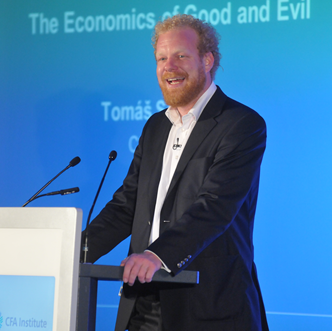
“Don’t sell economic stability to buy economic growth,” warned Tomáš Sedláček, chief macroeconomic strategist at CSOB Bank and author of The Economics of Good and Evil (Oxford University Press 2011), to an audience of investment professionals at the CFA Institute European Investment Conference in Prague. Sedláček’s unconventional view is that our problem is not lack of growth but too much of it. He believes that the role of the economist should not be to encourage economic growth but to decrease the swings of the business cycle.
Sedláček said that there are parallels between how a depressed economy is treated by today’s economists and how a depressed patient is treated by doctors. The economist’s prescription of running budget deficits and thereby increasing debt is similar to the doctor’s prescription of anti-depressants. The problem with both debt and anti-depressants is that they can become addictive.
“Our problem is not lack of growth but too much of it,” Sedláček said. An economy that uses debt to grow must continue to do so by taking on more and more debt or, alternatively, face a slowdown that will lead to bankruptcy. It is like owning a car that explodes when it stops, argued Sedláček.
In Sedláček’s view, European countries have amassed “a Mount Everest of debt” to continue to grow, which becomes a problem in economic slowdown. He contends that in the past, economists sold stability to buy growth but now we need to do the opposite: to sell growth to buy stability.
29 October 2012
How to Find Elusive Happiness at Work

Is happiness at work important to you? I guess the answer is yes. It probably is very important. After all, we spend so much of our life working. But after a weekend, do you feel excited about going to work on a Monday morning or does the thought make you feel ill?
At the recent Fifth Annual European Investment Conference in Prague, organised by CFA Institute, Alexander Kjerulf told us what he thinks makes people happy at work. At this conference, where industry thought leaders addressed an audience of investment professionals on topics including the eurozone crisis and the latest investment techniques, it was an unusual session. The topic was just as far from the minds of delegates as it was close to their hearts. However, Kjerulf was well placed to show the audience the way, as he is the chief happiness officer of Woohoo inc. Yes, you read that right: He’s a chief happiness officer, and our happiness is very much his business.
Kjerulf started his presentation with a message of hope. For those who think that their work is such that they can never find happiness, Kjerulf showed a YouTube video of Valerie, who cleans the ladies’ toilets at the Charlotte airport in North Carolina, United States. In the video, you will see a joyful Valerie on top of her work. Not only is she happy, but her happiness also seems to infect those using “Valerie’s Happy Restroom.” Kjerulf’s point: You can find happiness at work regardless of what you do.
Kjerulf believes that many companies get it wrong when it comes to making employees happy. They try to create a happy workplace through things like pay raises, bonuses, complimentary gym membership, or healthcare, but he believes this is not the answer. Kjerulf explained that a salary is what you need to pay expenses to live your life, but a salary does not bring happiness at work; this is the distinction companies fail to make in creating a happy work environment.
26 October 2012
Joachim Klement: How Personal Experience Can Determine Risk Preferences
Delegates at the Fifth Annual European Investment Conference were treated to a fascinating introduction to Joachim Klement’s views on how individual experiences affect risk preferences. As chief investment officer at Wellershoff & Partners Ltd., Klement has developed an incisive profile of this remarkable phenomenon.
He began his presentation by discussing the power of shared experiences. What Klement and his team have discovered is that people who experienced a recession between the ages of 18 and 25 are more likely than those who did not experience a recession to believe that government should reduce income inequalities. In addition, his team demonstrated that the greater one’s portfolio is allocated toward growth stocks, the greater one’s portfolio resembles the portfolios of those who attended the same university. Without asserting a specific hypothesis, he said it appears that we humans tend to self-organize into little herds of people.
Pankaj Ghemawat: Globalisation or Globaloney?
Pankaj Ghemawat began his presentation by asking delegates at the Fifth Annual European Investment Conference a series of provocative questions. How global are we? What patterns do we observe about our inter-connectedness? And finally, what are the implications for Europe?
Popular perceptions today are that the world is shrinking, technology is reducing the barriers to distance, and national borders are increasingly unimportant. Yet Ghemawat contends that despite the benefits and ease of technology, human behaviour still matters, distance still matters, and yes, borders still matter — and these factors overwhelm the perception of a small, frictionless world. Citing evidence from his primary research on the subject of globalisation, Ghemawat argued that we are a lot less globalised than many people perceive. He shared data highlighting the percentage of all telephone calls that are international (2%), the percentage of all citizens in a given country who are recent immigrants (3%), the percentage of all foreign direct investment (10%), and finally, the percentage of all exports relative to GDP (30%). Importantly, Ghemawat argued, most people overestimate the percentages in each of these categories by a substantial margin — hence, he refers to globalisation as “globaloney”.
Ghemawat reasons that we are not as connected as many perceive because of the law of distance — meaning that differences among groups of people determine the ability and willingness of different groups of people to interact with each other. These differences can be cultural (e.g., different tastes), geographical (e.g., physical distance and barriers), administrative (e.g., in the European Union or not in the European Union), or economic (e.g., differences in affordability and/or living standards). Moreover, these differences compound and help to explain the limited nature of globalisation today.
24 October 2012
Jan Straatman: You’re Building with the Wrong Blocks!
Conventional wisdom and investment practice over the last 20 years have disproportionately focused on asset class returns and risk profiles. A sense of urgency is now needed to build more effective risk management solutions, argued Jan Straatman, Global CIO of Lombard Odier, at the CFA Institute Fifth Annual European Investment Conference held in Prague, 18–19 October 2012. Given that the range of modern asset classes has apparently failed to deliver the desired diversification effects promised by optimisers and mathematical techniques, Straatman believes that risk management at the portfolio level has been found to be negligent.
Straatman developed his premise by first explaining four “problems” the modern fund manager faces:
- Although there has been a proliferation of new asset classes in the last two decades, the globalisation of the capital markets through company expansion and orchestrated multinational monetary policy has reduced the diversification impact across asset allocation. Read More
22 October 2012
Robert Merton: A New Approach for Macrofinancial Risks
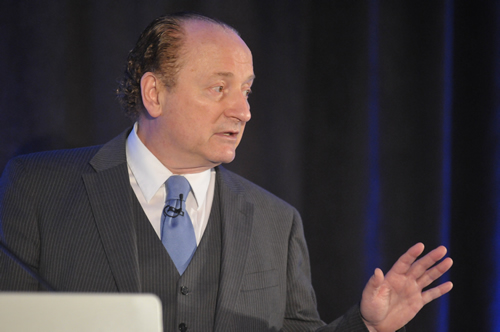
Nobel laureate Robert C. Merton challenged traditional models used by investors to measure sovereign and financial system credit risk and proposed an alternative framework during a keynote session at the CFA Institute European Investment Conference.
Merton began by arguing that any definition of sovereign debt should take into account another class of liabilities, top-up guarantees, which aren’t on the balance sheet but are just as real as those that are. For the United States, these guarantees amounted to an astonishing $17 trillion in 2010. “The values of these guarantees are enormous, particularly in times of stress,” Merton said. According to Merton, these explicit and implicit guarantees cause risk to propagate in substantial ways across the various sectors of the economy — household, corporate, financial, banking, and government sectors — as well as across borders. Merton is interested both in understanding what is going on with these guarantees and in measuring and monitoring risks.
Merton’s approach is based on contingent claims analysis (CCA), which models an issuer’s debt as a combination of risk-free debt and a short put option on the issuer’s assets. If the issuer defaults, the issuer has to give up the remaining value of the firm’s assets to the bondholder. The holder of the guarantee receives the promised value of the debt minus the value of assets recovered from the defaulting entity. So, the value of the guarantee, such as a credit default swap (CDS), is analogous to a put option on the assets of a borrower.
The Future of Private Wealth Management Is Digital
At the Fifth Annual CFA Institute European Investment Conference, Scorpio Partners founder Sebastian Dovey gave delegates a vision of the future in a session titled The Future of Private Wealth Management: The Next 20 Years. The presentation showcased new ways that firms market to private clients. It also focused on a skill that Dovey believes drives Scorpio’s success, which involves “understanding the mind of the millionaire.” Admitting that the private wealth industry does not often discuss the future, he stated that it is time for asset managers to focus on “what wealth is and what wealth needs.”
To demonstrate why the industry needs to change in order to survive and grow in the future, Dovey began by clarifying the issues facing the private wealth industry today. He insisted that practitioners should care about the future because of the significant problems they currently face, which include an economic model in trouble because of rising costs, revenues that are falling due to fee compression, competitive pressure on asset growth from other uses of capital, lack of growth in new money, and an industry that has only an anecdotal understanding of clients and their needs. Further complicating these issues is what Dovey describes as the “client revolution” — a growing number of customers who try to assess the true value of their investment advisers, while deciding if it is too risky to manage their own assets.
Suggesting a way to rectify some of these concerns, Dovey discussed “Future Wealth,” a project that he and his partners have been working on that attempts “to understand the anthropology of the wealth client.” He added, “We have been plotting what is important to wealthy individuals…in terms of parts of the customer journey (ranging from brand to customer experience in terms of the service model) and also in the context of the independent opinion you can get.” By asking millionaires about their experience with other industries, examining where they have spent equivalent amounts of capital, and determining the motivations for their actions, certain inferences can be made about what high-net-worth individuals (HNWIs) need from private wealth.
19 October 2012
The Traditional Alternative: Why Investing Should Return to the Stone Age

One of the founders and chairman of the 300 Club, Saker Nusseibeh, now CEO of Hermes Fund Managers, is devoted, along with his club colleagues, to promoting integrity in finance and investment. The club’s name derives from the 300 Spartans who held off the massive Persian invading force at Thermopylae in 480 BC. They did so not with ultimate conviction that their tiny group would defeat the thousands of Xerxes’s troops but in an effort to ignite and unify other fragmented Greek city-states that had not recognised the threat at their doorstep. In this, the Spartans succeeded. So Nusseibeh and his colleagues, who include leading lights in asset management, are trying to galvanize finance industry leaders to their noble cause.
With a doctorate in medieval history, in addition to his financial expertise, Nusseibeh brings a wealth of historical knowledge to his exposition, allowing him to step back and look at the big picture. When forming the 300 Club, he and his fellow chief investment officers questioned the basics of today’s investment practice, which they see as having parallels with the medieval alchemists who sought to create wealth from nothing.
What Are the Truths?
We believe we live in a globalised world. But as Nusseibeh pointed out, 100 years ago there were no more than 35–40 separate global trading blocs. Now there are more than 200 players — a big impediment to global interaction.
Read More
Whither the Euro? Seeking Resolutions for the Eurozone

A year is a long time in a stressed currency union. Last October, we conducted a poll of CFA Institute members based in Europe about the future of the eurozone. At that time, 70% of respondents agreed that a failure of the euro would be a failure for Europe. However, 63% believed that a breakup was unlikely. And even amongst those who thought otherwise, only 36% expected it to break up in less than a year. It turned out that the majority was right. So far.
Not surprisingly, a major theme of this year’s CFA Institute European Investment Conference in Prague was the prospect for the euro. Most speakers opined on the subject, sharing and supporting their various arguments.
Anatole Kaletsky, co-chair of GaveKal, laid out the necessary conditions for the long-term survival of the euro: political, fiscal, and monetary federalism. He stated that nothing less would safeguard the common currency and deemed central control of tax and spending, joint responsibility for debt and banking, and central bank support for federal debt essential to underpinning the unit. He added that in the near term, the European Central Bank‘s (ECB’s) “safety net” would save the euro, and there may be a continuation of the crisis, but a breakup would be unlikely.
Wolfgang Münchau, the European economics columnist for the Financial Times, was less certain. He described the rolling European sovereign debt crisis and the banking crisis as two drunks supporting each other to keep from falling. He admitted that the ECB’s new bond-buying programme, termed Outright Monetary Transactions (OMT), addresses many crisis points, especially the sovereign and bank debt problems, while breaking the circuit of ever worse expectations. But, he stated, OMT may never be taken up, or worse, it may create political resentment in Germany and reduce scope for any political manoeuvre. In any case, he believes the programme needs a banking union to be effective.