Watch Pippa Malmgren’s presentation on “Geopolitical Factors for Investors,” which was broadcast live from the CFA Institute Middle East Investment Conference on Monday 26 March 2012 at 17:30–18:15 AST.
cfai on livestream.com. Broadcast Live Free

Watch Pippa Malmgren’s presentation on “Geopolitical Factors for Investors,” which was broadcast live from the CFA Institute Middle East Investment Conference on Monday 26 March 2012 at 17:30–18:15 AST.
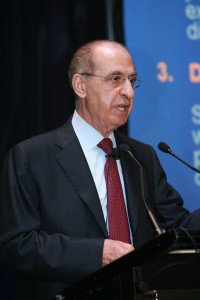
Mankind thrives on change and some of the greatest leaps forward have arisen in times of adversity. Timely then for Dr. George Abed, senior counselor and director for Africa and the Middle East at the Institute of International Finance, to deliver a presentation at the CFA Institute Middle East Investment Conference that focused on the transitions currently happening across the Middle East and North Africa (MENA).
While political hegemonies that have been in place for almost a century have been overturned in the space of a few months, countries including Egypt, Libya, Syria and Yemen, face an uncertain political future that may have costly economic implications. There is always a danger that a desire to alter all existing structures can actually damage a country’s potential. Abed hopes that political changes should not mean all progress made by previous regimes is erased but pointed to the poor showing of the MENA region in terms of international competitiveness.
Abed proposed three separate steps for reform, which, although targeted at the MENA countries, could easily be applied in Western Europe or the US. These included right-sizing the public sector, reducing uncompetitive wages and costs and investing in the future through education and technology.
By taking these steps, Abed believes the MENA countries could represent a great opportunity, not because of oil, but because of human capital. With a current 48% labor force participation rate, the Arab world lags well behind its emerging market neighbors. Of course, the limited role of women in the economy contributes to this figure, but reforms could change this.

To explore the economic implications of recent events in the Middle East, we interview Adeel Malik from Oxford University as he shares his insights from his research on “The economics of the Arab Spring.”
CFA Institute: Will the Arab Spring lead to substantial economic reform in the Middle East?
Dr. Adeel Malik: It should, but it is not necessarily true that it will. After the dust begins to settle on the political process, policy makers in the Middle East will be faced with the tough economic challenge of creating opportunities for its teeming millions. There is a risk the local elites will endure; they can reverse change or mold it in their favor. The current impasse in Egypt best illustrates this institutional dilemma. Real change requires not just a political opening, but also a change in the distribution of economic power.
How does the youthfulness of the region impact the economics of the Arab Spring?
An overwhelming proportion of the Middle East’s population now consists of young people under the age of 30, many unemployed. During the period 1996-2006, the labor force in Middle East and North Africa grew three times as much annually as in the rest of the developing world, resulting in one of the largest rates of youth unemployment in the world. In Jordan, for instance, more than 70 percent of the unemployed are under the age of 29 years. But while the demographics are evolving the economic structure remains rigid, unable to generate productive employment opportunities for new entrants to the labor force. An estimated 100 million jobs need to be created in the MENA region over the next decade or so.
Amid the escalating sovereign debt crisis in the eurozone and the revolutionary wave across the Arab world, CFA Institute has released the results of the second annual CFA Institute Middle East Survey which gauges opinions on the key issues currently facing investment markets in the region.
The survey of members and charterholders in the Middle East highlighted that while the global financial crisis and Arab Spring have undoubtedly undermined market confidence and contributed to financial uncertainty, it is clear that the majority of CFA charterholders and members believe that financial stability and economic growth will eventually return.
Respondents were asked about the effect of the global financial crisis in the Middle East in 2012. The majority of respondents believe that diversification of investments, fiscal policy, demand for new sukuks and bonds and oil prices will keep rising. In contrast they believe that liquidity, real estate prices and levels of trust will continue to decline this year.
In addition, the survey indicated that three quarters of respondents (75%) think that transparency of investment decisions and accountability, increased regulation of the markets, and improved financial reporting are the best ways the investment industry can rebuild trust in Middle East financial markets.
What is their problem with interest? This is the question that comes to many people’s minds when they see news reports on Islamic Finance and the notion that interest on monetary loans is prohibited – the Islamic prohibition of riba. Few reports try to explore the ‘problem’ but Tarek El Diwany, a speaker at the upcomingCFA Institute Middle East Investment Conference and Islamic Finance specialist, has done just that in a way that financial analysts can relate to.
Tarek, who grew up in England and was a derivatives dealer in the City of London, is now an Islamic Finance practitioner and writer. Tarek has become well-known for his critique of the nuts and bolts of capitalism, particularly compound interest and the proliferation of debt through fractional reserve banking, as explored in his book The Problem With Interest and his documentary, “Why Are We All in Debt?“.
While Tarek’s ideas are wide ranging, CFA Institute produced a video-interview with him (below) focusing on one specific issue: Is there a conflict between discounting and ecological sustainability? In other words, what is so problematical about requiring a compound return while living on a planet with such a fragile ecology?
Tarek contends that discounting underweights the long term. For example, a cash flow of £100 discounted for 30 years at 10% gives a present value of less than £6. On the other hand, sustainability issues, be it climate change or deforestation, are inherently long term, if not inter-generational. When these long-term sustainability issues are evaluated in the standard discounted cash flow (DCF) model, investing in an ecologically sustainable manner involves a cost and will likely emerge as a poor choice on purely financial grounds.

H. Richard Dallas, managing director of private equity at Gulf Capital, has almost three decades of experience with commercial transactions and investments in GCC countries. Gulf Capital specializes in investments in late-stage buyouts, growth capital, industry consolidations, and add-on acquisitions.
Mr. Dallas and Gulf Capital have made headlines in the Middle East with their investments in companies such as Consultant Radiology Centres, Saudi Arabia’s largest chain of diagnostic imaging centers, and with January’s purchase of a majority stake in Sakr Energy Solutions. In July 2011, Gulf Capital sold Maritime Industrial Services after spending five years increasing the firm’s profits, which was later recognized as the 2011 private equity “Deal of the Year” at the Private Equity World MENA Conference. Read More
Presentations from Pippa Malmgren, of Canonbury Group and Principalis Asset Management, and Henry Azzam, of Deutsche Bank, will be broadcast live from the CFA Institute Middle East Investment Conference.
Henry Azzam’s presentation, “The Changing Economic and Political Landscape of the Arab Region,” will take place Monday, 26 March 2012, 10:00–10:45 AST (03:00 EDT / 08:00 BST / 15:00 HKT).
Pippa Malmgren’s presentation, “Geopolitical Factors for Investors,”will take place Monday, 26 March 2012, 17:30–18:15 AST (10:30 EDT / 15:30 BST / 22:30 HKT).
If you can’t attend the conference in person, you can watch the presentations online — in addition to the live broadcasts, “The Changing Economic and Political Landscape of the Arab Region” and “Geopolitical Factors for Investors” will be available for viewing online after the event.
 Michael O’Sullivan is head of portfolio strategy and thematic research at Credit Suisse. He is also an independent member of the National Economic & Social Council, the advisory council to the Irish prime minister, and he published an article in The National discussing how past examples of regime change may show “Arab Spring” countries how to avoid economic pitfalls that could derail their efforts at political change.
In a recent interview with Professional Wealth Management magazine, Mr. O’Sullivan discussed the importance of considering the economic environment when selecting safe haven investments. During extreme market events, safe havens can become too popular and too overbought, which is when Mr. O’Sullivan and Credit Suisse emphasize the positioning and valuation risks to their clients.
“We stressed caution when gold reached $1900/2000 per ounce,” notes Mr. O’Sullivan, who also said that his firm will “sound the alarm on German bonds when their yield is being compressed down.”
For investors looking to protect their portfolio against political instability in the Middle East, Mr. O’Sullivan recommends “out of the money call” options on oil.
Michael O’Sullivan’s session at the Third Annual Middle East Investment Conference will focus more on the economies of the Arab Spring countries as he discusses “Economics of the Arab Spring: Lessons from the Past and Ideas for the Future.” You can register to attend the event to hear from Mr. O’Sullivan in Doha, Qatar, on 25–26 March 2012, and follow this blog for more speaker updates as the conference draws closer.
 Henry T. Azzam is chairman of the Middle East and North Africa (MENA) region at Deutsche Bank and has written five books on the region’s economy and capital markets. Dr. Azzam’s career in the MENA region includes time spent as chairman of the board of NASDAQ Dubai, chairman of Dubai International Financial Exchange, CEO of Jordan Investment Trust, and as an international advisory board member at the Saudi Stock Exchange (Tadawul).
Dr. Azzam is an expert on the Middle East and the economic influences specific to the region, and spoke with The Prospect Group in a recent interview. In this video, he discusses a number of topics, including the region’s need to develop a secondary market for bonds and sukuks, noting that “to have a liquid secondary market you need two things, more companies need to issue bonds and you need investors that are aware of these opportunities.”
Dr. Azzam will be discussing capital markets in the Middle East in greater detail at the Third Annual Middle East Investment Conference in Doha, Qatar, on 25–26 March 2012. You can register to attend the event to hear more, and follow this blog for more speaker updates as the conference draws closer.
 As director of the BNP Paribas Hedge Fund Centre at London Business School, Professor Narayan Naik is an authority on alternative investments and the role of hedge funds in investment portfolios. During his career, he has published a number of articles demystifying hedge funds and examining whether they can deliver alpha, as well as whether they are suitable retail investors.
2011 was a particularly busy year for Professor Naik, as he and his co-authors published hedge fund articles in four separate journals. Professor Naik’s work looked at whether hedge funds manage their return reporting to maximize their fees, the value of incorporating predictability into a hedge fund portfolio strategy, some of the key drivers of convertible arbitrage as an investment strategy, and whether incentives encourage fund managers to ignore their own superior information.
You can learn about the role of hedge funds in investment portfolios directly from Professor Naik during his session at the Third Annual Middle East Investment Conference in Doha, Qatar, on 25–26 March 2012. You can register to attend the eventto hear more, and follow this blog for more speaker updates as the conference draws closer.
CFA Institute is the global, not-for-profit association of investment professionals that awards the CFA and CIPM designations. We promote the highest ethical standards and offer a range of educational opportunities online and around the world.