

India’s Finfluencer Challenge: From Influence to Accountability
Social Media and Finfluencers: The India Experience
The rise of social media as an influential force in economics is a global phenomenon. India’s financial landscape is also changing quickly, driven by growing retail participation, increased interest in equities and derivatives, and the expanding influence of digital trading platforms. The nation’s rapidly expanding finfluencer market is testing a regulatory framework designed largely around traditional investment advisers and research analysts.
Limited awareness and the susceptibility of retail investors to misleading advice and exaggerated claims pose a significant challenge for regulators and policymakers. In this context, the recent CFA Institute report Clicks and Credibility 2.0: From Influence to Accountability, Disclosures, and Policy Impact makes important recommendations to address the challenges posed by finfluencers who operate outside existing regulatory requirements.
CFA Institute first examined this issue in its March 2025 report Clicks and Credibility: Understanding Finfluencers’ Role in Investment Decisions, which found that only 2% of the finfluencers studied were registered with the Securities and Exchange Board of India (SEBI), even though 33% provided explicit stock recommendations. It also found significant shortcomings in disclosures of sponsorships and financial affiliations.
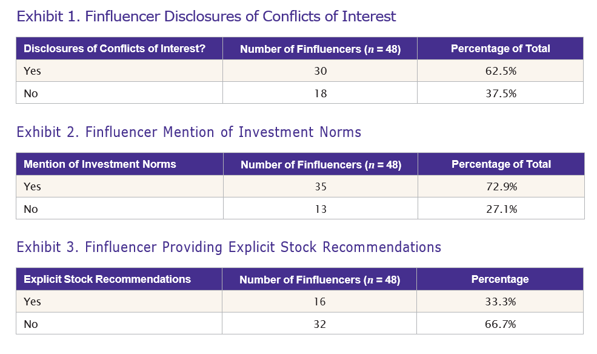
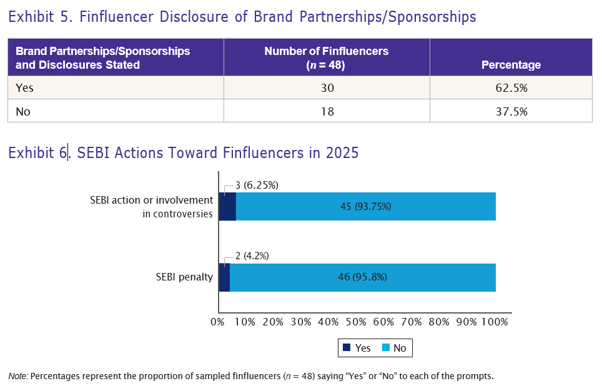
The new study revisited the sample from the first study and analyzed content from 48 finfluencers in India over the 10 months from January through October 2025. The latest findings show some progress, but also a persistent regulatory gap. Only three of the 48 finfluencers studied, or 6.3%, were SEBI-registered, while 16, or 33.3%, provided explicit buy, hold, or sell recommendations. More than one-third did not adequately disclose conflicts of interest, and the same proportion did not disclose brand partnerships or sponsorships.
These figures point to more than a compliance problem. They reveal a policy gap between the growing reach of financial content on social media and regulatory frameworks developed for more conventional forms of investment advice and promotion.
Our latest report explores how the sector has continued to evolve. We have segmented our sample of 48 finfluencers in India to ensure representativeness across three different tiers of followers:
- 26 Mega-influencers (more than one million followers),
- 19 Macro-influencers (100,000 to one million followers), and
- 3 Micro-influencers (fewer than 100,000 followers).
We analyzed the respective content for 10 months, from January 2025 through October 2025. The following exhibits highlight important data points and the aspects they cover. Exhibits 1–3 show the number of finfluencers in the sample who:
- Disclose conflicts of interest if any (Exhibit 1)
- Mention investment norms such as key investment considerations and aspects such as fees, risks, tax implications, and lock-in periods (Exhibit 2)
- Provided explicit stock recommendations such as buy, hold or sell (Exhibit 3)
The following exhibit highlights how many of them in our sample of 48 finfluencers are SEBI registered (Exhibit 4).

The Exhibits 5 and 6 show how many in our sample of 48 finfluencers:
- Disclose their brand partnerships/sponsorships (Exhibit 5)
- SEBI acted against or who were involved in controversies (Exhibit 6)
- SEBI has imposed penalties on (Exhibit 6)
Our study points to a partial shift in the finfluencer landscape. The share of SEBI-registered finfluencers has increased to 6% (Exhibit 4), but the proportion offering explicit stock recommendations remains unchanged at 33% (Exhibit 3). In addition, more thana third of finfluencers (37%) fail to adequately disclose conflicts (Exhibit 1), such as sponsored content or affiliate marketing. The increase in registration is encouraging, but it has not been matched by a decline in explicit stock recommendations. That persistence suggests that the core policy challenge is not simply bringing more creators into the regulatory perimeter, but clarifying when social-media activity crosses into regulated advice.
SEBI’s Approach to Finfluencer Content
SEBI’s finfluencer regulation depends on the activity involved. When social-media content moves beyond general financial awareness or education into investment advice, recommendations, or claims about securities returns or performance, it can enter territory already governed by SEBI’s framework for investment advisers and research analysts.
That activity-based approach is important, but applying it online can be difficult. The distinction between education, promotion, and advice is not always obvious to creators or investors.
Our research illustrates that tension. One-third of the finfluencers studied provided explicit stock recommendations even though only a small minority were registered. Disclosure practices were also inconsistent. The study identified weaknesses in communicating investment considerations such as fees, risks, tax implications, and lock-in periods, as well as conflicts arising from parallel business interests and movement toward closed or offline channels that can be harder to supervise.
The result is an environment in which investors may encounter highly influential content without having the information needed to assess a creator’s qualifications, incentives, or regulatory status.
Recommendations for Policymakers and Regulators
Incremental enforcement alone will not close the gap between financial influence and regulatory accountability. Our recommendations for regulators, including SEBI and other relevant authorities, focus on stronger collaboration, closer monitoring, and continued efforts to refine frameworks that capture finfluencer activity and track how the line between education and investment advice is changing. Key recommendations include:
- Strengthen international cooperation: Collaborate with global regulators to address cross-border finfluencer activity and enforcement challenges related to investment communications.
- Introduce standardized disclosure frameworks: Develop clear, consistent rules on how and where finfluencers must make disclosures (e.g., within videos, not just in captions).
- Develop a Finfluencer Code of Conduct: Establish principles for transparency, accountability, and ethical financial communication. Also, strengthen oversight of high-risk and speculative product promotions.
- Promote investor awareness campaigns: Educate investors on how to identify credible advice and understand the risks associated with finfluencer content. Raise awareness of the difference between terms like “SEBI compliant” and “SEBI registered.”
- Strengthen fraud detection and reporting mechanisms: Enhance surveillance (including the use of AI) of financial content online, improve reporting channels, and collaborate with social media platforms to identify misleading content.
The Way Forward
Finfluencers are now an important part of how many retail investors receive financial information. Their rise has broadened access to financial education, but it has also made the distinction between information, promotion, and regulated advice harder to navigate.
The central challenge is structural. Digital financial influence sits at the intersection of securities regulation, commercial promotion, platform governance, and jurisdictional reach.
India’s policy response should therefore move beyond a predominantly reactive model toward one that is more preventive, coordinated, and transparent: standardized disclosures, clearer guidance on the boundary between education and advice, stronger cooperation with platforms and regulated firms, and deeper coordination with overseas regulators.
The objective should not be to restrict legitimate financial education. It should be to ensure that when online influence begins to function as investment advice or financial promotion, accountability follows influence. That is increasingly essential to investor protection and market integrity in a digital financial system.