

One Money, Many Rails: Keeping Digital Money Fungible
A dollar should be worth a dollar, whoever issues it and wherever it settles. CFA Institute is calling on issuers, regulators, market infrastructures, and investors to keep it that way as money moves onto digital rails through deliberate design, regulation, and disclosure.
Our Enterprising Investor article, “Digital Money’s New Plumbing,”described three forms of digital money and the two regulatory models shaping them. This piece goes a step further: it argues that divergence among these forms of digital money is a market integrity problem, and it lays out what CFA Institute believes regulators, standard setters, and market infrastructure providers need to do about it. Digital money can only deliver on its promise of cheaper, faster, more programmable payments if a dollar remains a dollar wherever or however it settles. As these forms of digital money develop, that guarantee is eroding, and the response must be deliberate.
When One Dollar Is No Longer the Same as Another
The most prominent risk is that digital money denominated in the same currency stops trading at par across issuers and financial rails. The Bank for International Settlements (BIS) refers to this issue as affecting the singleness of money: claims in a currency redeem at par with central bank money, with finality, in all states of the world, so that a recipient never has to check whose claim it is (BIS 2026). For example, a dollar stablecoin, a tokenized deposit, and a central bank digital currency (CBDC) all read as one dollar on a screen. They differ in who owes the money, what backs it, who is permitted to redeem it, and when settlement becomes final.
In the US, a tokenized deposit is a bank liability, potentially eligible for deposit insurance up to USD250,000 (thanks to FDIC oversight), issued by an institution with discount-window access. A payment stablecoin under the GENIUS Act is not deposit-insured, and its issuer has no automatic entitlement to Federal Reserve accounts; the Fed’s proposed “skinny” master account, the Payment Account, would grant qualifying issuers settlement access while withholding interest, daylight overdrafts, and discount-window borrowing (GENIUS Act 2025; Liang 2026; Garratt and Shin 2023). Same denomination, however, different positions in the hierarchy of money.
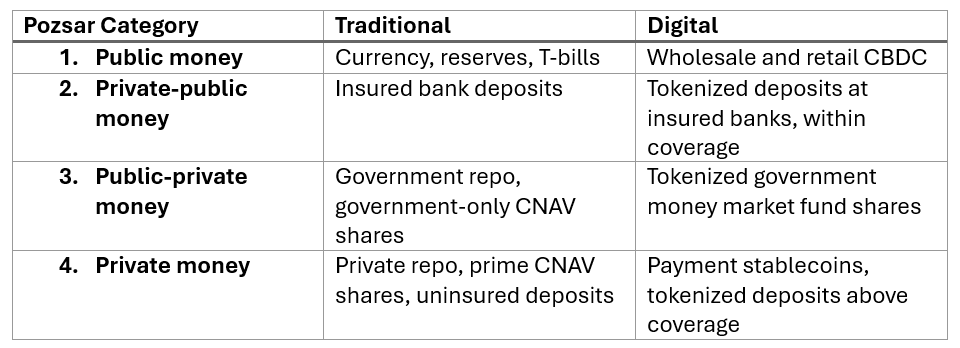
A 2021 report from CFA Institute, Money in COVID Times (Ben Chekroun et al. 2021) applied the money-view framework to the post-2008 system, following Pozsar (2014) in ranking money claims by a single test: the strength of the holder’s ability to convert at par, on demand. Two things set the rung: credit protection asks who stands behind the claim if the issuer fails; liquidity protection asks whether the issuer can meet redemptions at par without selling assets into a falling market. The same framework applies to digital money, with each form occupying a rung in that same structure.
Exhibit 1. Traditional and Digital Forms at Each Level of the Money Hierarchy
Fragmentation Is Forming Along Three Lines
- Jurisdictional. As of August 2025, the Financial Stability Board (FSB) counted 11 jurisdictions with finalized crypto-asset frameworks but only five with finalized stablecoin regimes, and described implementation as incomplete, uneven, and inconsistent (FSB 2025). The United States has taken the private-issuance path, licensing stablecoin issuers without insuring their tokens. China has restricted private issuance and built public rails, extending the e-CNY across borders through mBridge, a multi-central-bank platform for cross border-payment and foreign exchange settlement. Blocs are forming around these choices. The EU is pursuing a digital euro while limiting large-scale usage of non-euro tokens under MiCA, and Hong Kong SAR sits on both sides at once, one of the few jurisdictions with a finalized stablecoin regime, and a founding mBridge participant (FSB 2025; EU 2023).
- Sectors and use cases. Different instruments are winning different niches, and the split follows their structure. Stablecoins are bearer instruments on open networks, transferable peer-to-peer without reference to the issuer: they dominate crypto settlement and are moving into cross-border payments and remittances, where the World Bank’s average remittance cost of roughly 6.5% (Remittance Prices Worldwide, Issue 53 ) leaves room for a cheaper payment rail. Tokenized deposits are account-based claims on a bank’s own ledger, transferable only among that bank’s customers or pre-approved counterparties, and their main use so far is corporate treasury and intragroup settlement for multinationals. CBDCs are appearing in policy-led wholesale corridors. Across the forms of digital money, the adoption by practitioners is already evident, though still early-stage: an EY-Parthenon survey of 350 companies found 13% using stablecoins today, with more than half of non-users expecting to adopt within a year, mostly for cross-border payments. The money one holds starts to depend on what one is doing with it, and a single treasury can end up holding several dollars that are not fungible with each other. Even within the same instrument, the problem still occurs: a stablecoin issued natively across many chains is not the same claim everywhere, and cross-chain protocols connect only some of them.
- Capital markets. The central promise of tokenized settlement is delivery versus payment in one atomic step, which requires the security and the money to sit on the same ledger or on ledgers that can talk to each other. Often the cash leg is simply missing: on one of the largest live tokenized repo platforms, the securities are tokenized while the cash still sits off chain on conventional rails (GFMA 2025). Where tokenized securities do settle against different, non-interoperable monies, the effects compound. The IMF’s assessment is that if settlement assets, liquidity pools or collateral frameworks differ across platforms, fragmentation can impair par convertibility, reduce netting efficiency, and complicate crisis management (Adrian 2026). Collateral that cannot move between venues has to be held twice, and margin posted in one money does not offset exposure in another. The money underpinning the market stops being fungible, and liquidity splits along the same lines.
Investor Perspective
Fragmentation reaches investors in five distinct ways, each rooted in how a rail is built rather than in the currency it claims to carry.
- Instrument and venue. A single issuer’s stablecoin minted across multiple blockchains is not one fungible claim, because interoperability between chains remains partial. A tokenized deposit lives inside one bank’s permissioned ledger, and interbank settlement between private ledgers does not yet exist. A CBDC stops at the border.
- Finality. Central bank money and tokenized deposits settle within established payments law. A stablecoin transfer is final only once the network’s own governance treats it as final.
- Par risk. A CBDC is a direct claim on the central bank. A tokenized deposit is a bank liability that may carry insurance. A stablecoin holds its 1:1 convertibility to the fiat currency through arbitrage that is conducted only by a handful of counterparties.
- Regulatory arbitrage. Stablecoin issuance migrates toward whichever jurisdiction demands the least onerous requirement (e.g. for the reserve ratio and the nature of the reserves), while CBDCs entrench jurisdictional boundaries.
- Operational risk. Operational risk is concentrated in bridges and a handful of stablecoin issuers on one side, and in the single permissioned platform run by one bank or one central bank on the other (Aronoff et al. 2026; Adrian 2026).
Each of these fault lines is a channel through which the singleness of money erodes — and each is a reason CFA Institute believes voluntary, ad hoc interoperability is not a sufficient response.
CFA Institute has already staked out a position on how to close these gaps. Our two-part research series, An Investment Perspective on Tokenization — Part I and An Investment Perspective on Tokenization — Part II ( Soni, Fines, and Sun 2025; Bandi, Fines, and Soni 2025), sets out four positions that apply directly here:
- Regulation should stay adaptive and technology-neutral while preserving legal certainty.
- Rules should be harmonized across jurisdictions, including aligned definitions of digital assets and cross-border recognition of property rights.
- Interoperability should be understood to cover legal and regulatory alignment, not only technical compatibility between chains.
- Investor protection should be reinforced through stronger disclosure requirements and market surveillance.
On the cash side specifically, CFA Institute has argued that the industry is unlikely to embrace stablecoins widely until safekeeping and the transparency of reserves improve (Fines 2024). The CFA Institute Systemic Risk Council has gone further, supporting licensed and supervised issuance backed dollar for dollar by high-quality liquid assets, and opposing fractional-reserve models operating outside a prudential perimeter (CFA Institute Systemic Risk Council 2025).
What CFA Institute Is Calling For
The evidence above points to one conclusion: the singleness of money will not preserve itself. It has to be designed for, regulated for, and disclosed for, across every rail carrying the same currency. CFA Institute is calling on four groups of actors to treat that as an explicit objective.
Regulators and policymakers. CFA Institute recommends that regulators apply rules based on activity rather than on labels or technology, so that instruments performing the same economic function carry the same obligations. Standards for par convertibility, redemption, and interoperability should be set in regulation rather than left to market practice — recognizing that redemption rights available only to a wholesale tier do not protect the wider market. Policymakers should also work toward cross-border coordination, since divergence between blocs drives fragmentation and arbitrage.
International standard-setters. The BIS, FSB, and IOSCO have issued recommendations on crypto assets and stablecoins, but the FSB reports that implementation remains uneven. CFA Institute is calling for a common set of settlement, messaging, and interoperability standards spanning all forms of digital money, with the singleness of money treated as an explicit objective rather than an inherited assumption.
Issuers and market infrastructure. CFA Institute recommends that banks, stablecoin issuers, and financial market infrastructures disclose reserve composition and redemption terms in full, including which parties may redeem and on what timetable. Interoperability should be built into system design rather than added later, and governance should assign clear responsibility for settlement finality and for failure. Operational and cyber resilience should match the systemic role these rails now play.
Investors and practitioners. CFA Institute urges investors and practitioners to establish, for every instrument they hold or use, which money settles their trades, who owes it, what backs it, whether redemption is direct or intermediated, and when settlement is final. These are questions of fact, and the answers differ by instrument — investors should not assume that a claim which reads as “one dollar” behaves like one in every part of the world.
Conclusion
The potential gains in speed, efficiency, and programmability, together with reductions in cost, could be transformational, but these benefits depend on a dollar remaining a dollar wherever it settles. In effect, the fungibility of money must be maintained while technology improves the efficiency of transactions. This is the standard against which CFA Institute assesses digital money and encourages regulators, standard setters, issuers, and investors to do the same. The evidence behind this position, and a fuller framework spanning payments, banking, and capital markets, will be the subject of future CFA Institute research.
References
Adrian, Tobias. 2026. Tokenized Finance. IMF Note No. 2026/001, April. https://www.imf.org/-/media/files/publications/imf-notes/2026/english/insea2026001.pdf.
Adrian, Tobias, Yaiza Cabedo, and Tmmaso Mancini-Griffoli. 2026. The Rise of Tokenization: Deciphering New Trends in Payments. IMF Note No. 2026/006. https://www.imf.org/-/media/files/publications/imf-notes/2026/english/insea2026006.pdf.
Aronoff, Dan, Chris Calabia, Anders Brownworth, Ashwanth Samuel, and Neha Narula. 2026. The Hidden Plumbing of Stablecoins: Financial and Technological Risks in the GENIUS Act Era. MIT Digital Currency Initiative, February. https://www.dci.mit.edu/projects/hidden-plumbing-stablecoins.
Bandi, Giovanni, Olivier Fines, and Urav Soni. 2025. An Investment Perspective on Tokenization — Part II: Policy and Regulatory Implications. CFA Institute Research and Policy Center. https://rpc.cfainstitute.org/research/reports/2025/investment-perspective-tokenization-part-ii.
Bank for International Settlements (BIS). 2026. Anchoring Trust in Money: Innovation beyond Stablecoins. Annual Economic Report 2026, Chapter III, 23 June. https://www.bis.org/publ/arpdf/ar2026e3.htm.
Ben Chekroun, Anas Taoufik, Olivier Fines, Sviatoslav Rosov, Simon Johnson, and Ronald A. Kurtz. 2021. “Money in COVID Times: A Primer on Central Bank Response Measures to COVID-19.” CFA Institute (November). https://rpc.cfainstitute.org/policy/positions/money-in-covid-times.
CFA Institute Systemic Risk Council. 2025. CFA Institute Systemic Risk Council Urges Prompt Oversight of Stablecoin Issuers, March. https://www.systemicriskcouncil.org/2025/03/cfa-institute-systemic-risk-council-urges-prompt-oversight-of-stablecoin-issuers/.
European Union (EU). 2023. Regulation (EU) 2023/1114 on Markets in Crypto-Assets (MiCA), Articles 23 and 58. https://eur-lex.europa.eu/eli/reg/2023/1114/oj/eng.
EY-Parthenon. 2025. Stablecoins in Focus: Navigating the New Digital Financial Landscape. Key Takeaways from EY-Parthenon’s 2025 Stablecoin Survey of Corporates and Financial Institutions, June 2025. EY-Parthenon survey report (PDF).
Financial Stability Board (FSB). 2025. Thematic Review on FSB Global Regulatory Framework for Crypto-asset Activities, 16 October. https://www.fsb.org/uploads/P161025-1.pdf.
Fines, Olivier. 2024. CBDCs: Towards a Tokenized Future. CFA Institute, 25 April. Available at: https://www.cfainstitute.org/insights/articles/cbdcs-towards-a-tokenized-future.
Garratt, Rodney, and Hyun Song Shin. 2023. Stablecoins versus Tokenised Deposits: Implications for the Singleness of Money. BIS Bulletin No. 73, 11 April. https://www.bis.org/publ/bisbull73.htm.
GENIUS Act. 2025. Guiding and Establishing National Innovation for U.S. Stablecoins Act, Public Law 119–27, July. https://www.congress.gov/119/plaws/publ27/PLAW-119publ27.pdf.
Global Financial Markets Association (GFMA). 2025. The Impact of Distributed Ledger Technology in Capital Markets. https://www.gfma.org/wp-content/uploads/2025/08/3.-deep-dives-impact-of-dlt-in-cap-mkts-final.pdf.
Liang, Nellie. 2026. What Are the Differences between Payment Stablecoins and Tokenized Bank Deposits? The Brookings Institution, 14 April. https://www.brookings.edu/articles/what-are-the-differences-between-payment-stablecoins-and-tokenized-bank-deposits/.
Pozsar, Zoltan. 2014. “Shadow Banking: The Money View.” Office of Financial Research Working Paper 14-04. https://www.financialresearch.gov/working-papers/files/OFRwp2014-04_Pozsar_ShadowBankingTheMoneyView.pdf.
Soni, Urav, Olivier Fines, and Jinming Sun. 2025. An Investment Perspective on Tokenization — Part I. CFA Institute Research and Policy Center. https://rpc.cfainstitute.org/research/reports/2025/investment-perspective-tokenization.
World Bank. 2025. Remittance Prices Worldwide, Issue 53, March 2025. Washington, DC: World Bank. FSBWorld Bank — Remittance Prices Worldwide, Issue 53, March 2025.