

The SpaceX IPO Puts Shareholder Rights to the Test
A wave of high-profile technology and artificial intelligence (AI) companies moving toward the public markets could accelerate a long-running erosion of shareholder rights. Although less than 10% of S&P 500 companies have multiclass share structures, some of the market’s largest companies—including Alphabet, Meta Platforms, and Berkshire Hathaway—give substantially greater voting power to insiders than to public shareholders. Low-vote and non-voting shares have consequently become an established feature of US public markets.
Drawing on a CFA Institute pulse survey conducted through LinkedIn and its member communities, this blog post examines how respondents view dual-class shares, perpetual founder control, and weakened listing and index-inclusion standards. Although the survey findings are indicative rather than statistically representative, they support a clear principle: Regulators, exchanges, and index providers should not dilute established governance protections to accommodate high-profile IPOs. Innovation should not come at the expense of corporate accountability, transparency, or meaningful shareholder rights.
Enter SpaceX
The recent SpaceX IPO intensifies the trend toward greater insider control and diminished voting power for public shareholders. Its governance structure sharply limits public shareholders’ ability to influence board composition, executive compensation, and other matters designed to hold corporate leaders accountable. Other prominent private technology companies considering public offerings could seek similar arrangements, making the treatment of SpaceX an important precedent for future listings.
The underlying concern is not simply that founders retain influence. Rather, it is that public investors may assume the economic risks of ownership without gaining meaningful mechanisms to oversee directors or challenge management. As Adolf Berle and Gardiner Means observed nearly a century ago in their book The Modern Corporation and Private Property, separating ownership from effective control can weaken corporate accountability. That risk grows when insiders consolidate control and public shareholders lose the tools traditionally available to protect their interests.
Disenfranchisement
These recent limits on shareholder participation and voting rights raise fears of a renewed divide between ownership and control, in which public investors bear the economic risks while insiders retain effective control with limited accountability. From reduced proxy and shareholder engagement to increased barriers to shareholder proposals, the message appears increasingly clear: Public shareholders are encouraged to provide capital but have less influence over corporate decision-making. Unfortunately, history has not been on the side of shareholders. Governance risks increase when corporate oversight is concentrated among insiders and when public shareholders have fewer mechanisms to hold directors accountable.
What We Asked Survey Participants
As investors anticipate potential future listings from high-profile private companies, including major AI ventures and other marquee offerings, it is worth asking a fundamental question: Does any of this matter to investors?
To examine how investors view this changing balance of power, CFA Institute conducted a pulse survey through LinkedIn and its member communities over several weeks during mid-2026. Because the survey had limited distribution and did not use a representative sampling methodology, its results should be viewed as an indicator of sentiment rather than a statistically representative measure of investor opinion.
Respondents were asked about three increasingly important features of the IPO market:
- dual-class share structures,
- founders retaining perpetual supermajority voting control after an IPO, and
- waiving governance eligibility requirements for listing IPO shares on major stock exchanges and including such shares in related market indices.
Key Findings
Respondents Strongly Support Existing Index Inclusion Standards
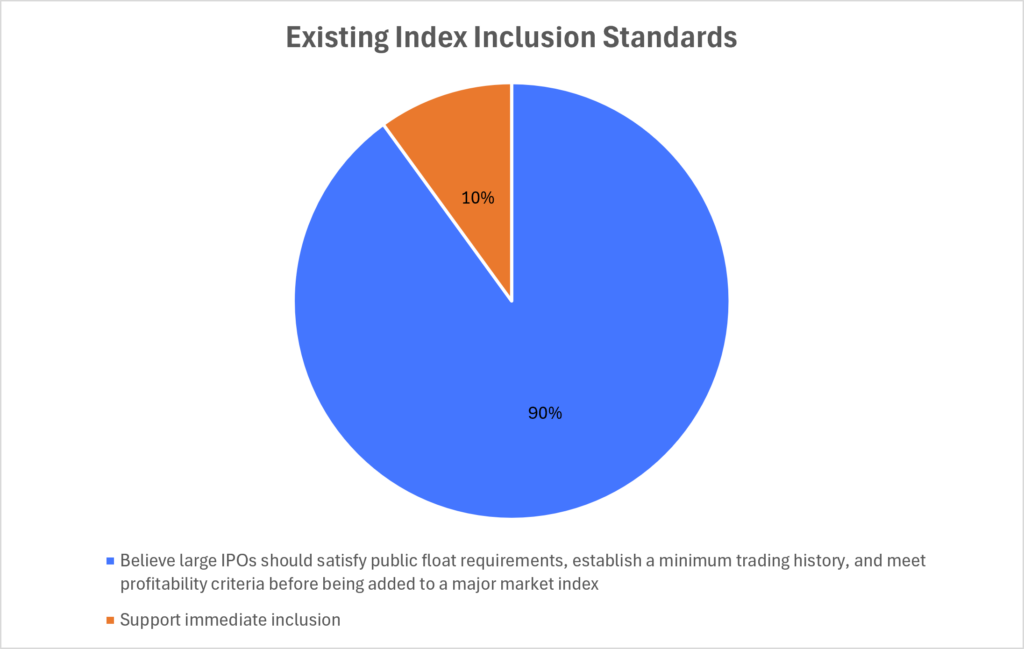
The most decisive finding related to index eligibility. As illustrated in Exhibit 1, 90% of respondents (175 of 195) believe that large IPOs should satisfy public float requirements, establish a minimum trading history, and meet profitability criteria before being added to a major market index. Only 10% (20 respondents) supported immediate index inclusion.
Exhibit 1. Existing Index Inclusion Standards
Source: CFA Institute pulse survey, mid-2026
This result suggests strong support for maintaining standards designed to protect market integrity and ensure that index inclusion reflects sustained public market performance rather than market enthusiasm alone.
Mixed Views on Dual-Class Structures
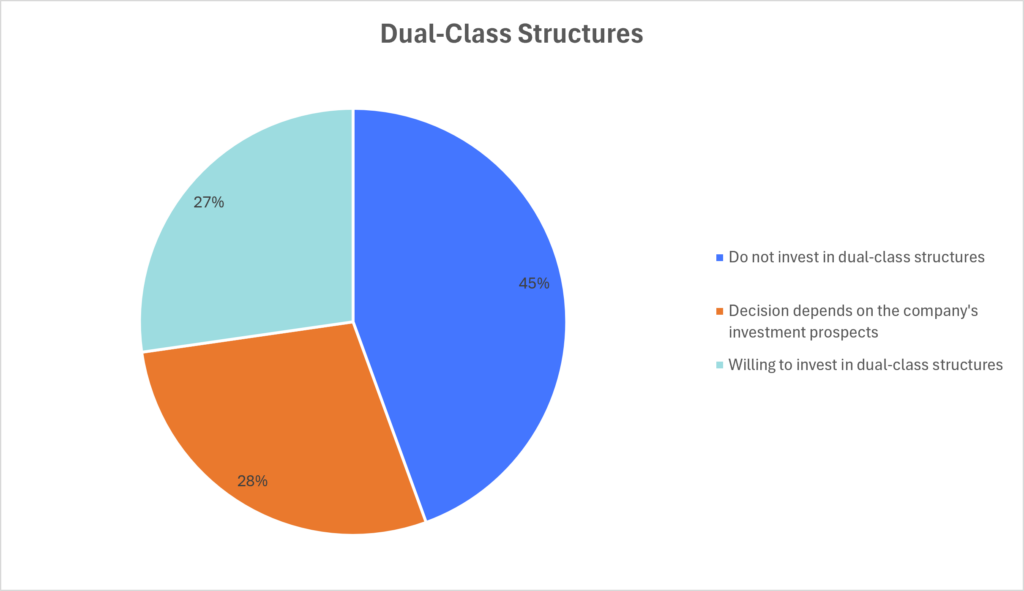
Views were more divided regarding dual-class share structures. As Exhibit 2 shows, 44% of respondents said they do not invest in companies with dual-class shares, while 28% indicated that the decision depends on the company’s investment prospects. Another 27% said they are willing to invest in such companies.
Exhibit 2. Dual-Class Structures
Source: CFA Institute pulse survey, mid-2026
Note: Percentages are rounded so that they sum to 100%.
These responses suggest that although governance concerns remain important, many investors are willing to weigh them against perceived business opportunities and growth potential.
Founder Control Remains Controversial
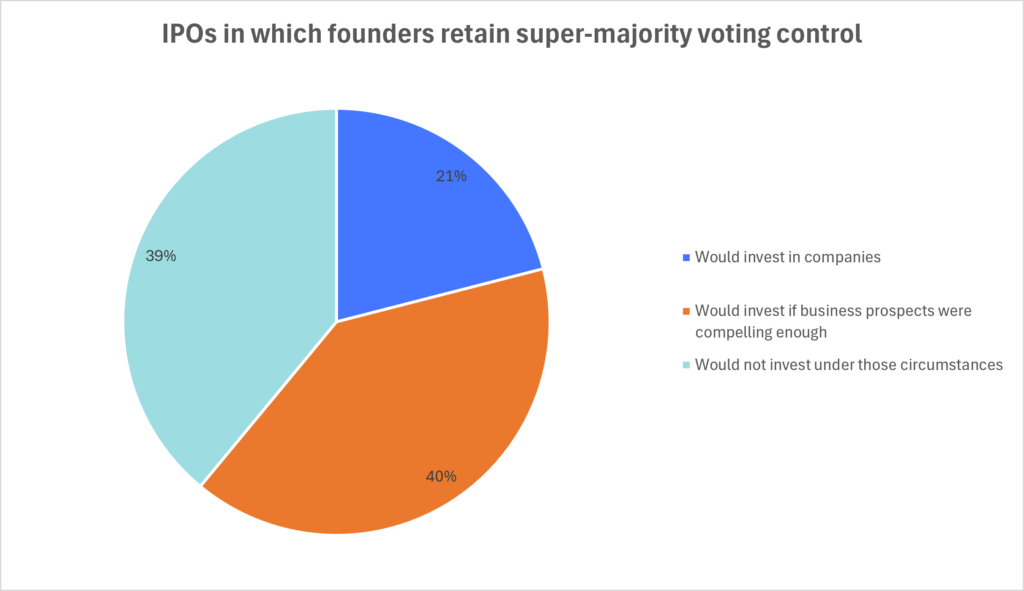
A different pattern emerged when respondents were asked about IPOs in which founders retain supermajority voting control. As Exhibit 3 illustrates, 21% said they would invest in such companies, 40% said they would invest if business prospects were compelling enough, and 39% said they would not invest under those circumstances. Phrased differently, nearly two-thirds of respondents appear to balance governance considerations against expectations for future returns, indicating that governance alone is rarely a decisive factor.
Exhibit 3. IPOs in Which Founders Maintain Supermajority Control
Source: CFA Institute pulse survey, mid-2026
Different Governance Risks Require Different Safeguards
The issues examined in the survey should not be treated as interchangeable. Dual-class shares can allow founders to pursue a long-term strategy without constant market pressure, but they can also weaken corporate accountability. Regulators and exchanges should therefore require clear disclosure of voting disparities, while policymakers should renew debate on creating sunset provisions that prevent unequal voting rights from becoming permanent.
Index inclusion raises a separate market-integrity issue. Index providers should consistently apply public-float, trading-history, and profitability requirements rather than accelerate the inclusion of prominent new listings. This is the policy position most strongly supported by the survey, in which 90% of respondents favored established index eligibility requirements over immediate inclusion.
Does Governance Matter?
The differences among index-inclusion requirements, dual-class share structures, and perpetual founder control matter because investors do not respond to every governance concern in the same way. The survey shows overwhelming support for established index-inclusion standards but more mixed views on dual-class shares and founder control. Governance protections therefore cannot depend entirely on investors refusing to buy shares that offer weak shareholder rights.
The findings highlight a growing reality in today’s IPO market. Short-term traders who seek to capitalize on initial public offerings place zero emphasis on governance. At the same time, many IPO sponsors retain significant control and largely view the offering as a liquidity event for founders and early investors.
Although high-profile IPOs may boost listing activity and generate investor excitement, they also risk normalizing governance structures that permanently weaken shareholder rights and board accountability. That risk will grow if regulators and exchanges weaken investor protections and listing standards further.
The prevailing narrative surrounding many of these offerings is straightforward: These companies represent the future, growth opportunities are compelling, and investors should focus on innovation rather than governance. Unfortunately, governance gaps do not disappear simply because a company operates in a cutting-edge industry.
The Consequences
The survey results are encouraging considering the finding that investors continue to value fundamental governance protections, particularly when it comes to stock exchange standards and index inclusion. As public markets evolve, the challenge will be ensuring that short-term enthusiasm for high-profile companies does not come at the expense of long-term accountability, transparency, or investor rights. Otherwise, the corporate governance erosion epidemic may deepen, with more serious long-term consequences for market integrity and shareholder oversight.

